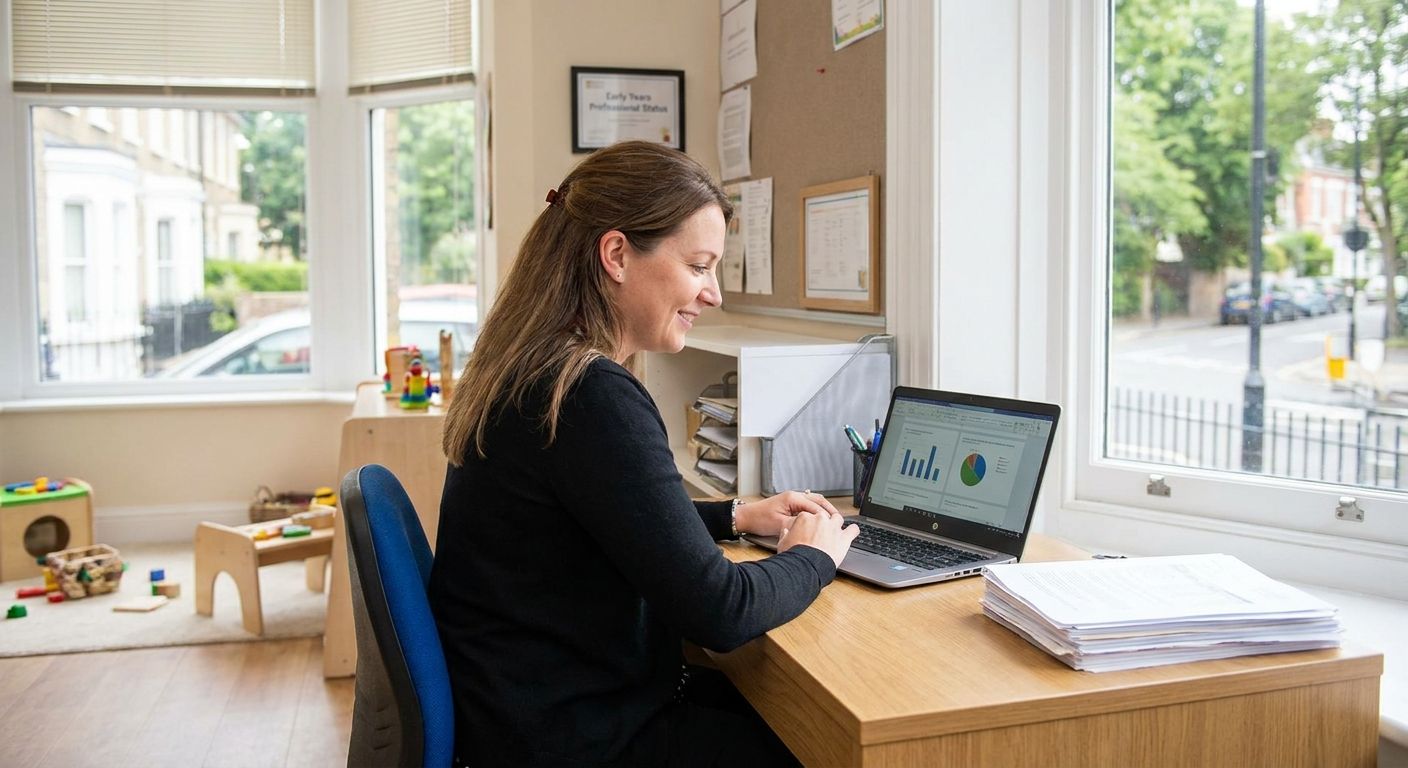
Qualifying as an early years practitioner online in 2026 is straightforward if you know the correct route, the right qualification level, and what employers actually require. This guide covers every step — from entry requirements through to your first role in a nursery or reception setting.
TL;DR: The standard entry-level route is the Level 2 Diploma for the Early Years Practitioner, completed entirely online. You need no prior qualifications to enrol. The diploma is Ofsted-recognised, employer-accepted across the UK, and can be finished alongside work or caring commitments. If you already hold a Level 2 and want to move into a senior room leader or deputy manager role, a Level 3 qualification is the natural next step. Start with the Level 2 Diploma for the Early Years Practitioner if you are new to the sector.
Why this matters in 2026
Early years settings across England are required by the EYFS statutory framework to maintain staff-to-child ratios, and those ratios depend on holding an approved qualification. Without a recognised Level 2 or above, you cannot count in ratio — which directly limits your employability and your pay grade. Getting qualified online removes the barrier of attending a college campus while keeping you working or job-ready.
What you'll need
Before you enrol, check these prerequisites:
- Age: 16 or over (most providers ask for 19+ for fully funded routes)
- Prior learning: No existing childcare qualifications required for Level 2
- Placement hours: Most Level 2 diplomas require a minimum number of observed practice hours in a real early years setting — confirm this with your provider before enrolling
- Device and internet access: All coursework, tutor contact, and assessments are delivered through an online learning management system (LMS)
- Time commitment: Budget 6–12 months for a Level 2 diploma studied part-time alongside work
- English and maths: Functional Skills at Level 1 are often required; Level 2 (equivalent to GCSE grade 4/C) strengthens your application significantly
The steps
Step 1 — Confirm which qualification level you need
The sector uses two main entry points. Level 2 is the minimum to count in Ofsted ratio as an early years practitioner. Level 3 qualifies you as an early years educator and unlocks higher-responsibility roles. If you have no previous childcare training, start at Level 2. If you already hold a full Level 2 childcare qualification, you can move directly to Level 3.
The wrong level wastes money and time. Check the job descriptions for roles you are targeting — most nursery job ads specify "Level 2 minimum" or "Level 3 preferred" in the person specification.
Expected outcome: You know whether to enrol on a Level 2 or Level 3 programme before spending a penny.
Common mistake: Assuming any childcare-related certificate counts as a full Level 2. Short awareness courses and CPD certificates do not satisfy Ofsted's approved-qualifications list. Only a full Level 2 Diploma for the Early Years Practitioner (or equivalent on the DfE list) does.
Step 2 — Choose an accredited online provider
Not every online course leads to a qualification Ofsted accepts. The qualification must appear on the Department for Education's list of approved qualifications for early years settings. Awarding organisations such as NCFE, CACHE, and Pearson issue the most widely recognised versions of the Level 2 and Level 3 diplomas.
When comparing providers in 2026, check:
- The awarding body (NCFE, CACHE, Pearson — not an unrecognised internal certificate)
- Whether a qualified assessor will observe your practice placement
- Tutor contact hours per week
- What the LMS looks like — some platforms are far easier to use than others
Bright Pathway's Level 2 Diploma for the Early Years Practitioner is delivered fully online through a structured LMS with tutor support and assessed placement observations built into the programme.
Expected outcome: You are enrolled on a qualification that will appear on the DfE-approved list and satisfy Ofsted inspection.
Common mistake: Choosing the cheapest option without verifying the awarding body. A £99 online "childcare certificate" is not the same as an accredited Level 2 Diploma.
Step 3 — Secure your practice placement
Online theory delivery does not remove the need for hands-on placement. Ofsted and the awarding bodies require observed practice — typically in a registered nursery, pre-school, children's centre, or reception class.
If you are already working in an early years setting, your workplace counts as your placement. If you are new to the sector, you need to arrange a voluntary or paid placement before your observations begin. Most providers give you a placement finder pack or guidance document — ask for it at enrolment.
- Contact local nurseries and pre-schools directly; many actively seek placement students
- CRB/DBS check at Enhanced level is required before you set foot in any setting with children
- Agree your hours with the setting manager — typically a minimum of one day per week throughout the qualification
Expected outcome: A confirmed placement agreement with a registered early years setting, signed before observation units begin.
Common mistake: Leaving placement sourcing until after you have started the online units. Some units cannot be signed off without concurrent placement evidence.
Step 4 — Work through the online units
A Level 2 Diploma for the Early Years Practitioner covers units including child development, safeguarding, EYFS principles, health and well-being, and supporting children's play and learning. Units are released sequentially through the LMS.
For each unit:
- Read the learning materials (typically 1–3 hours per unit)
- Complete any formative activities or self-assessments
- Submit your assignment or portfolio evidence to your assessor
- Receive written feedback and, where needed, resubmit
Set a study schedule at the start. Two to three hours of focused study per week, sustained across 9–12 months, is enough to complete a Level 2 diploma without burning out.
Expected outcome: Completed and assessor-signed units building toward your qualification certificate.
Common mistake: Submitting portfolio evidence without referencing specific EYFS statutory guidance. Vague answers get referred back, which delays your certificate by weeks.
Step 5 — Complete your observed practice assessments
Your assessor (either visiting in person or using video observation, which many providers now accept in 2026) must observe you working directly with children and sign off your practice competencies. This is the part most learners underestimate.
Prepare for observations by:
- Reviewing the assessment criteria for each unit before the observation date
- Asking your placement supervisor for a mock observation session
- Keeping a reflective journal throughout your placement — assessors look for evidence of professional thinking, not just doing
Video observation submissions must usually meet minimum quality standards (clear audio, unobstructed view of practice, child consent forms signed). Check your provider's technical requirements in advance.
Expected outcome: All practice units signed off by a qualified assessor, with evidence uploaded to your portfolio.
Common mistake: Conflating "being observed" with "passing the observation." If the assessor cannot see sufficient evidence of a specific criterion, the visit does not count. Ask which criteria they are observing before they arrive.
Step 6 — Achieve your certificate and register with your employer
Once all units are complete and internally quality-assured, the awarding body issues your Level 2 Diploma certificate. Most awarding bodies post certificates within 6–10 weeks of final sign-off in 2026.
Once qualified:
- Add the qualification to your CV using the full title: "Level 2 Diploma for the Early Years Practitioner"
- Provide your employer with the certificate number so they can verify it with the awarding body
- Check whether your local authority Early Years team requires any additional registration
- Begin planning your Level 3 progression if you are targeting room leader or deputy manager roles
For learners who want to progress, Bright Pathway's Level 3 Early Years Qualification Upgrade from Level 2 outlines the direct progression pathway.
Expected outcome: An Ofsted-recognised Level 2 Diploma certificate in your name, accepted by UK early years employers.
Common mistake: Waiting for the certificate before applying for roles. Most employers accept a "pending certificate" letter from your provider while the awarding body processes your paperwork.
Troubleshooting
Problem: My employer says my qualification is not on the DfE approved list.
Fix: Cross-reference your qualification title and awarding body against the DfE's current approved qualifications list (published on GOV.UK). If it is not listed, the qualification does not satisfy ratio requirements. Contact your provider immediately.
Problem: I cannot find a placement.
Fix: Contact your local authority's Early Years team — most maintain a list of settings willing to host placement learners. Childcare charities and children's centre networks are also good contacts. Start this process at enrolment, not when you need the placement.
Problem: My assessor has not been in contact for weeks.
Fix: Escalate to the Internal Quality Assurer (IQA) at your training provider. Every regulated provider has an IQA responsible for learner progress. If that fails, contact the awarding body directly using your learner registration number.
Problem: I failed a unit and do not know why.
Fix: Request written feedback specifying which assessment criteria were not met. Resubmit with direct reference to those criteria. Most diplomas allow at least one resubmission per unit at no extra cost — confirm this in your enrolment terms.
Problem: I am working full time and falling behind on units.
Fix: Speak to your tutor about a revised completion plan. Most online providers in 2026 allow extensions without penalty if agreed in advance. Do not go silent — providers can withdraw enrolments after extended periods of inactivity.
Problem: I am not sure whether to study Level 2 or jump straight to Level 3.
Fix: Check your existing qualifications against the DfE approved list. If you hold a full Level 2 childcare qualification from any point in your career, you are eligible for Level 3. If not, start at Level 2 — skipping it means your Level 3 certificate alone may not satisfy some employer requirements.
Tools and resources
- Level 2 Diploma for the Early Years Practitioner — Bright Pathway's accredited online diploma, the primary route for new entrants to the sector in 2026
- Best Level 2 Early Years Practitioner Courses Online — a comparison guide for choosing between online providers
- DfE Early Years Qualifications List — GOV.UK (search "approved qualifications early years" for the current list; updated periodically)
- EYFS Statutory Framework — the DfE document that sets ratio and qualification requirements for all Ofsted-registered settings
- Your local authority Early Years team — free guidance on local placement support and funding eligibility
What to do next
If you are ready to enrol, the Level 2 Diploma for the Early Years Practitioner at Bright Pathway is the fastest accredited route into the sector for 2026. Once qualified, the natural next step is upgrading to Level 3 — the Level 3 Early Years Qualification Upgrade from Level 2 guide explains exactly what that involves, including entry requirements, unit differences, and typical completion timelines.
FAQ
What qualifications do I need to become an early years practitioner?
The minimum qualification to work in ratio in an Ofsted-registered setting is a full Level 2 Diploma for the Early Years Practitioner. No prior childcare qualifications are required to enrol on the Level 2 diploma, though functional skills in English and maths at Level 1 are typically expected.
Can I qualify as an early years practitioner entirely online?
Yes — in 2026, accredited Level 2 and Level 3 early years diplomas are available fully online. Theory units are completed through an LMS, and practice observations can be conducted via video. You still need a placement in a registered early years setting for your observed assessments.
How long does it take to qualify as an early years practitioner online?
A Level 2 Diploma typically takes 9–12 months studied part-time alongside work. Completion time depends on how many hours per week you study and how quickly you arrange and complete your practice observations.
How much does an early years practitioner qualification cost?
Costs vary by provider and funding status. In 2026, online Level 2 diplomas range from approximately £300 to £700 if self-funded. Adult Education Budget (AEB) funding may cover costs in full for eligible learners in England — check eligibility with your provider at enrolment.
Is an early years practitioner the same as a nursery nurse?
"Nursery nurse" is an older job title. The current sector terminology, aligned to the EYFS framework, is "early years practitioner" at Level 2 and "early years educator" at Level 3. Many employers still use the older title in job ads, but the qualifications referred to are the same.
What is the difference between Level 2 and Level 3 early years qualifications?
Level 2 qualifies you as an early years practitioner, working under supervision and counting in Ofsted ratio at the base level. Level 3 qualifies you as an early years educator, enabling you to take on room leader responsibilities and work more autonomously. Most management roles specify Level 3 as a minimum.
Do online early years qualifications count with Ofsted?
Yes, provided the qualification appears on the DfE's approved qualifications list and is awarded by a recognised awarding body such as NCFE, CACHE, or Pearson. The delivery method (online vs. classroom) does not affect Ofsted recognition — only the qualification title and awarding body matter.
Can I work while studying for my early years practitioner qualification?
Yes. Online delivery is specifically designed around working adults. If you are already employed in a nursery or pre-school, your workplace can serve as your placement, which makes completing the qualification significantly more efficient.
One last thing
The Level 2 Diploma for the Early Years Practitioner is the only Level 2 childcare qualification specifically referenced by name in Ofsted's ratio guidance. Other Level 2 health or care qualifications — including some general care diplomas — do not automatically satisfy the early years ratio requirement. If you are targeting a nursery role specifically, the qualification title matters: make sure "Early Years Practitioner" appears explicitly on your certificate.