
What is Workplace Coaching?
Workplace coaching refers to a systematic employee development process in which experts coach and mentor employees to improve their performance, acquire skills, and enhance professional development. It is concerned with the potential of an individual, as it includes giving feedback, support, and action plans that are in line with the objectives of the organisation. Coaching, unlike traditional training, is more individualised, as employees are motivated to own their development.
Coaching has become an important aspect of managing people in contemporary workplaces. It creates an environment or culture of cooperation, trust, and lifelong learning. Organisations are therefore making investments in employee development programmes through coaching, which entails developing leadership, performance, and communication skills, which are the fundamental elements of long-term business success.

Why Coaching Matters for Employee Development
Coaching equips employees with the ability to do their best, as it equips them with continuous advice and positive feedback. It also develops critical skills like decision-making skills, problem-solving skills, and interpersonal communication skills. The more employees feel self-aware and confident, the more they will start playing a role in advancing the strategic goals of the company in a more significant manner.
Besides, coaching helps organisations retain talent by enhancing personal development and job satisfaction. It makes the workplace a good place to work in, where each individual feels appreciated and encouraged to move forward. Regardless of the executive or performance coaching, the influence on morale and productivity is enormous.
Different Types of Coaching in the Workplace
There are numerous types of coaching that are applicable to a purpose in the organisation. The various kinds of coaching most prevalent in the workplace setting are listed below, and there are real-life examples of their implementation included.
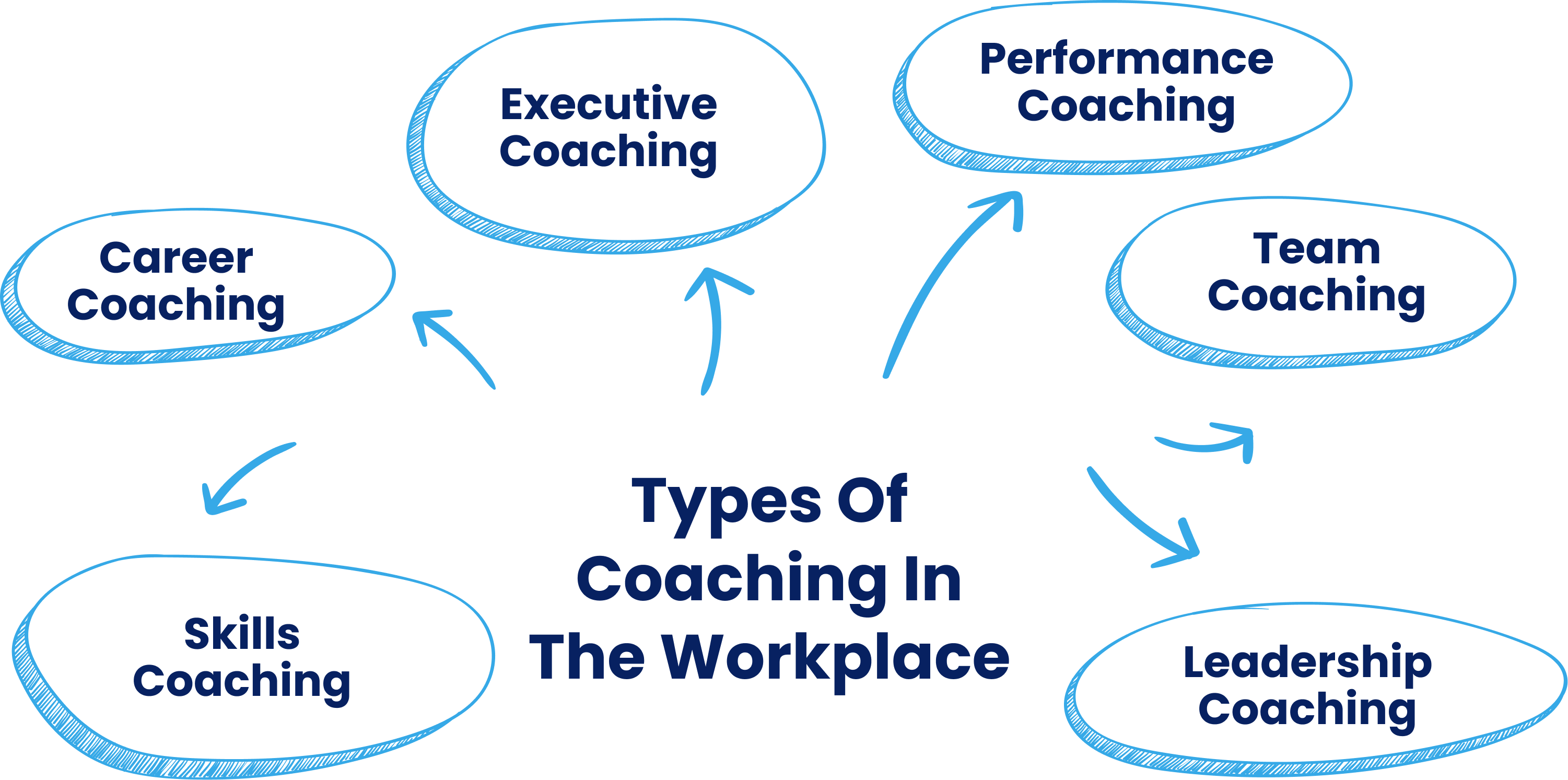
Executive Coaching
Executive coaching focuses on senior executives and managers who undertake strategic decisions. It is focused on making leadership more effective, emotionally intelligent, and more impactful on the organisation.
For instance, a chief executive officer may collaborate with an executive coach to enhance his or her interactions with the board members or deal with change in the company on a broader scale. Such coaching helps leaders to go through complicated business issues without losing trust and focus.
In practice: sessions usually run 60–90 minutes once a month, with more reflection than instruction. Because the power dynamics and confidentiality needs are different, executive coaching is normally delivered by someone external rather than a line manager.
Performance Coaching
Performance coaching is aimed at enhancing the performance of an employee in his day-to-day life. It entails establishing goals, finding areas of improvement, and preparing plans on how to improve them.
For instance, a sales representative works with a coach to perfect their sales techniques for clients and achieve monthly goals. This targeted coaching may eventually lead to a measurable improvement in confidence and performance.
In practice: run short weekly conversations of 15–20 minutes that focus on one behaviour at a time, and ask what got in the way before suggesting a fix. Keep it separate from any disciplinary conversation, or the person becomes defensive instead of open.
Career Coaching
Career coaching assists you in exploring and strategising your career paths. It is perfect when a person wants a promotion, a change of career, or when they need to know their long-term directions.
You might be an employee who is expecting a change in job position, moving out of project management to HR management. The career coach would take them through the process of evaluating transferable skills, creating a development plan, and preparing to take up new duties.
In practice: start with where the person wants to be in one to three years, then work back to what needs to happen in the next 90 days. Allow 45–60 minutes, because rushed career conversations produce generic advice nobody acts on.
Team Coaching
Team coaching is intended to increase teamwork, communication, and team building. It works particularly well with the dynamics and performance of teams.
For instance, when a department faces internal conflict, team coaching sessions would be used to build trust and communication. The coach assists the team to get aligned with their objectives and put up more effective modes of working together.
Skills Coaching
Skills coaching aims at cultivating particular skills or competencies. It can be brief and very specific on a skill area.
For instance, you can be a customer service agent who has been coached on skills to excel in problem-solving and compassion when handling customers. Such coaching makes sure that the employees possess the skills required to address the changing job demands.
In practice: break the skill into three to five sub-tasks and coach one at a time, watching the learner do the task rather than demonstrating it. Expect measurable competence within two to four weeks for a moderately complex skill.
Peer Coaching
Peer coaching pairs colleagues at a similar level rather than a manager and their report. It works well for sharing skills across teams and in situations where hierarchy would make honest feedback harder.
For instance, two team leaders with complementary strengths might meet fortnightly using a simple structure: what’s working, what’s stuck, and one action each. Without that structure, sessions drift into general chat. Peer coaching is also the type most often skipped in UK workplaces, not because it doesn’t work but because nobody is given ownership of setting it up.
Leadership Coaching
Leadership coaching can be used to enhance the skills of an upcoming or current leader on how to inspire, influence, and manage others. It is an amalgamation of executive and performance coaching, but it deals more with people management and communication.
For example, a new team leader who was recently promoted may be coached on how to effectively delegate tasks, how to motivate his or her team members, and how to constructively handle feedback.
What are the Different Coaching Styles?
The effectiveness of coaching is determined by the type of coaching and style of coaching applied by a coach. Both have an impact on the tone and effectiveness of the sessions; they must be selected depending on the personality and objectives of a person.
Autocratic Coaching
The coach is directive in autocratic coaching, and they establish explicit rules, expectations, and instructions. This style is especially effective in cases where there is a need for structure and discipline.
For instance, an autocratic coach can also apply this to a manufacturing environment that is sensitive to safety and precision, where the coach can take the workers through a step-by-step process to ensure that standards are maintained at all times.
Democratic Coaching
Democratic coaching encourages open communication and shared decision-making between the coach and the coachee. It promotes feedback, consideration, and shared problem-solving.
A manager who applies this style may consult the team members on matters related to the project before establishing the project objectives, making them feel that they own the project and are motivated.
Laissez-Faire Coaching
In Laissez-Faire Coaching, the employees have the freedom to make decisions and experiment. The coach does not give a lot of direction but is there when someone requires help.
This style is best applicable to highly skilled or creative professionals, such as software developers or designers, who are able to perform optimally when they are given the freedom to seek out innovative ways of doing things on their own.
Holistic Coaching
Holistic coaching considers both the personal and professional well-being of the coachee. It understands the fact that individual problems, attitude, and way of life all affect performance in the workplace.
For instance, a holistic coach can assist an employee in dealing with stress and work-life balance, besides increasing productivity. This strategy can assist in the general development instead of professional skills.
What You'll Need Before You Start Coaching
- A clear definition of the problem you’re coaching for: performance, skill, career or strategy
- 30–60 minutes of uninterrupted time per coaching conversation
- A way to track progress, such as a shared document, an LMS note or a one-page action plan
- Basic questioning technique (open questions, not instructions)
- If you want the skill recognised formally, a Level 3 Award in Education and Training for corporate trainers, which covers coaching and mentoring theory as part of the wider teaching and training syllabus
Choosing the Right Type of Coaching
The selection of the appropriate kind of coaching would be based upon the priorities of your organisation, the structure of your team, and the developmental needs of the individual. To illustrate, executive or leadership coaching would be the best option in case you need to enhance the effectiveness of leadership succession. In case you are interested in the improvement of skills or the effectiveness of a team, performance or team coaching can bring quick outcomes.
A quick way to diagnose the right type is to ask whether the issue is about output, capability, direction or strategy. The answer points to performance, skills, career or executive coaching respectively, with peer coaching working alongside any of them as a lighter-touch add-on.
At Bright Pathway, we understand that professional development needs flexibility and support. Our commitment to quality and Ofqual-approved education, including Education and Training Courses and Internal Quality Assurance Training (IQA), is an indication of our dedication to ensuring that professionals develop and become effective leaders in their respective workplaces.
Measure and Adjust
Every type of coaching needs a measurable outcome agreed at the start: a number, a deadline or a specific behaviour change. Review progress after four to six weeks. If nothing has moved, the type of coaching chosen was probably wrong, not the coach.
Troubleshooting Common Coaching Problems
- The person being coached goes quiet or defensive. Performance coaching has probably been blended with criticism, so separate the two conversations and lead with a question, not a statement.
- Sessions run long with no clear outcome. No structure was agreed at the start. Name one goal and one timeframe before the next session.
- Peer coaching pairs stop meeting after a few weeks. There’s no accountability loop. Add a shared note both people update, even briefly.
- Career coaching produces generic advice. The coach jumped to solutions before understanding the goal. Restart with “where do you want to be in 18 months?” and hold back advice in the first session.
- Skills coaching isn’t sticking. Practice was too short or too infrequent. Increase how often the skill is practised before making sessions longer.
- Executive coaching feels too close to management. The coach isn’t independent enough; this type needs distance from the organisation chart.
Tools and Resources
- A one-page coaching log per person: date, type, goal and outcome
- A Level 3 Award in Education and Training for corporate trainers, which covers the theory behind these coaching types
- A shared calendar with fixed coaching slots, because ad hoc coaching rarely survives a busy quarter
Frequently Asked Questions
What are the main types of coaching in the workplace?
The most common types are performance, skills, career, peer, team, leadership and executive coaching. Each solves a different business problem and runs on a different timeframe, from weekly performance check-ins to monthly executive sessions.
Is coaching different from mentoring?
Yes. Coaching is usually structured around a specific goal with a set timeframe, while mentoring is longer-term and relationship-based, often without a fixed end date.
How long should a workplace coaching session last?
Performance and skills sessions typically run 15–30 minutes, career sessions need 45–60 minutes and executive sessions often run 60–90 minutes. Matching the length to the type matters more than keeping sessions short.
Do managers need a qualification to coach?
No qualification is legally required, but structured training such as a Level 3 Award in Education and Training reduces inconsistency and gives managers a shared framework, which matters more as teams grow.
What’s the difference between performance coaching and discipline?
Performance coaching is developmental and forward-looking; discipline is a formal process tied to policy. Blending the two in one conversation confuses the person being coached and can create HR risk.
The Future of Coaching in Modern Workplaces
Technology, accessibility, and data-driven understandings are shaping the future of coaching in the workplace. Online coaching systems enable employees to receive professional help anywhere and anytime. This facilitates professional development among those who work as remote workers or in an international team.
In the near future, coaching is going to become one of the supports of contemporary talent development strategies. Organisations that now adopt varied forms of coaching are producing a strong, forward-thinking workforce that is capable of coping with tomorrow’s challenges with strength and competence.
Related Guides
Take the next step
Courses related to this guide
- Level 3 Award in Education and Training (AET)The introductory qualification for teaching or training adults, studied online.
- Level 5 Diploma in Teaching (Further Education and Skills)The full teaching qualification for further education and skills, studied online.
Ofqual-regulated qualifications, studied online. Browse all courses or talk to an advisor.